
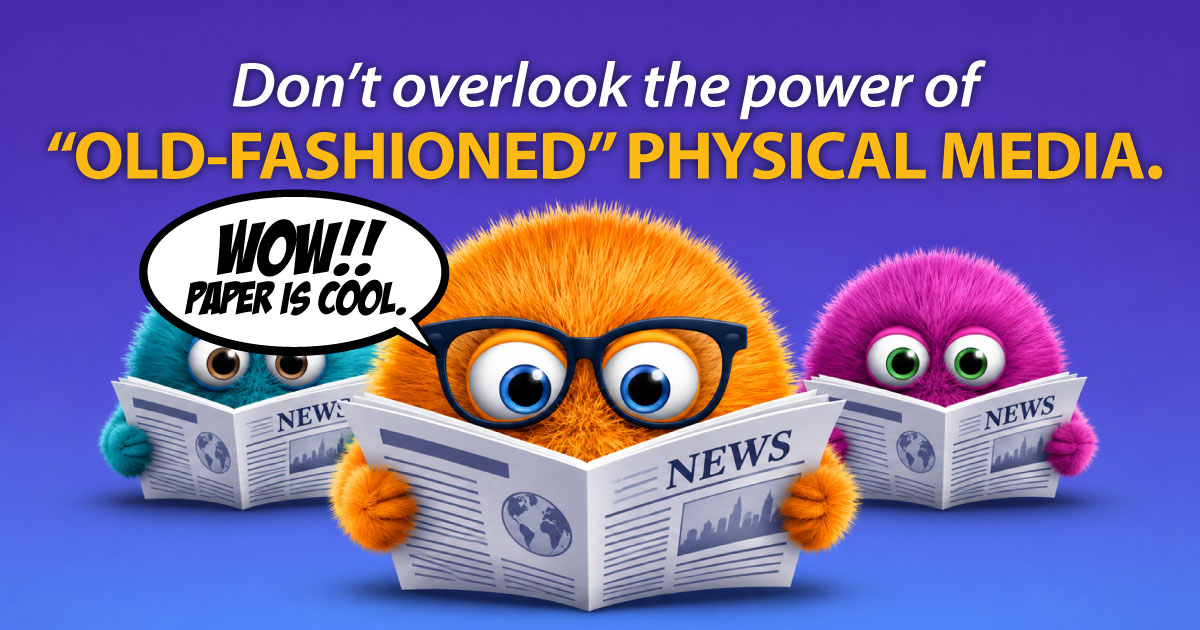
There’s more to media than social and digital
It seems like all the marketing attention these days is on social media and digital advertising. And it’s wonderful to be able to set up campaigns almost instantly, stop worrying as much about deadlines, and get so much real-time data about views and clicks.
But it’s important to remember that there’s still a place for “old-fashioned” print and direct mail in your marketing mix. By combining and coordinating digital and physical media, you can get far more bang for the buck than with either alone.
The trust gap
The percentages vary depending on who you ask, but it’s clear that consumers trust things like direct mail and print advertising far more than, say, search advertising and social media posts. Credit unions are in the business of trust, so that’s worth paying attention to.
There are many reasons, but a lot of it has to do with permanence and perceived effort. Print ads and direct mail are a physical record of the claims made, and consumers are aware that the level of effort and costs are significant. No one puts something in the paper or magazine, or up on a billboard that they’re not willing to stand behind, and no one ever got a computer virus from a newspaper ad. The same goes for direct mail; you have something you can point to.
It’s also about convenience and respect for the consumer’s time and attention. A direct mail piece or magazine ad can be picked up later when you have time; you’re not expected to make a decision and click right then and there, and you aren’t interrupted in the middle of something else.
Bypassing AI and algorithm fatigue
An emerging reason many traditional media, especially physical media, can work well is that they still require human effort. Most people are well aware that the ads and content they see online are targeted, chosen, and often created by algorithms and AI. And of course, many people have learned to ignore online advertising, and lots of web-savvy folks use ad blockers.
A poster, billboard, print ad, or direct mail is a way around that discomfort, and places the consumer more in control of their attention and time.
Dwindling reach… but lower costs and tighter focus and integration.
The elephant in the room here is that the reach of “traditional” print media is dwindling and fragmented. A lot of newspapers and magazines have gone under as circulation dwindles and advertisers move dollars online.
The good news is that every surviving publisher also has a robust digital publishing presence, with online editions, newsletters, special editions, social media, and online display advertising. It’s one-stop shopping for integrated, consistent physical and digital media campaigns, with plenty of data to gauge effectiveness.
Publications these days know they need to compete and offer value in both worlds, and can offer compelling package deals.
Mailboxes still matter
Although postage costs have risen, targeting direct mail and getting your message into the right mailboxes is easier than ever. Digital printing and deep data make it possible to print and send small quantities to very tightly targeted groups. You can even use digital printing to customize the message and offer for each person.
And of course you can use EDDM (Every Door Direct Mail) to target specific neighborhoods very economically. EDDM paired with a compelling offer can be a great way to make sure everyone knows about the branch around the corner.
In the rush to take advantage of the convenience, speed, and data streams returned from online marketing, don’t overlook the power of integrating “old-fashioned” physical media into the mix.

- There’s more to media than social and digital - November 12, 2026
- Five reasons your website is a fright - October 27, 2026
- Five things I learned from two CU conferences in two weeks - October 13, 2026